Why take my baby to a swim class?
A class gives your baby a playful introduction to the water while you learn how to support them and enjoy pool time together.
Do infant classes replace water supervision?
No. Babies need close, constant adult supervision in and around water, including after they have attended lessons.
Why Take Parent and Baby Swim Lessons?
For families in Northeast Florida, water is part of life. Pools, beaches, and boat days may be familiar, but bringing a baby into the water can still feel new. Where should you hold them? What if they are unsure? What should their first class actually accomplish?
AQUAfin’s parent and baby lessons give you a warm, guided place to start. The goal for a young infant is a positive experience together, with plenty of support for the adult in the pool.
Make pool time something you share
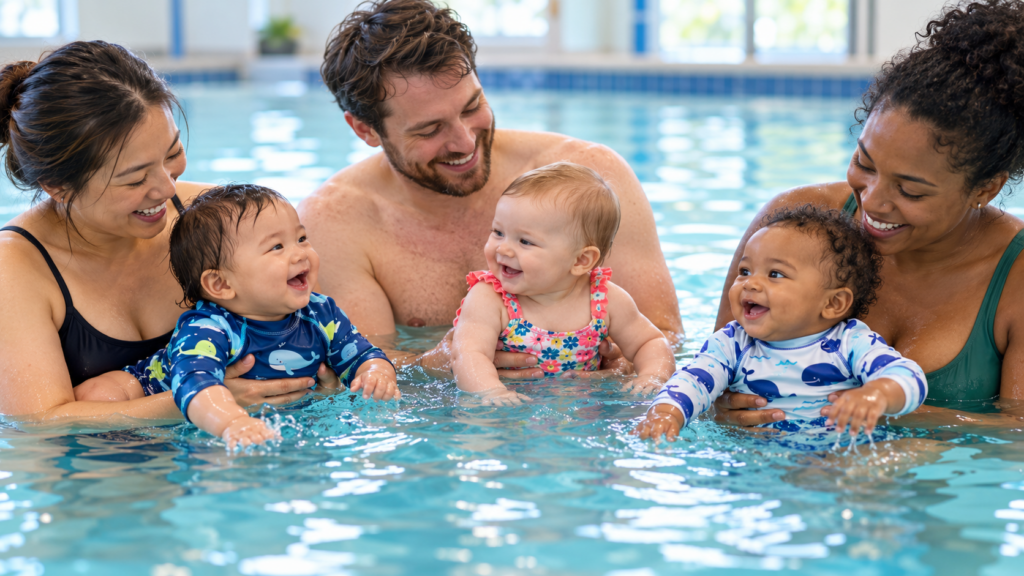
In class, you are right there with your baby. You join the songs, support each movement, and notice what makes your little one smile or settle in. It is time set aside to be together, without expecting your baby to perform a skill.
Some babies take in every detail before they seem ready to join an activity. Others reach for the water right away. Your instructor can help you follow your child’s cues and let comfort develop gradually.
Give your baby room to explore
The pool offers a different kind of play. Your baby can feel the water move, look toward other children, and move their arms and legs while you support them. These are enjoyable experiences in their own right.
Research into larger developmental benefits is still limited. One small study found differences in specific balance and grasping abilities among children who had taken baby swimming classes, but its authors called for further research. Claims that baby swim lessons raise IQ or improve memory go further than that evidence supports.
Grow more comfortable as a parent
A baby’s first class is often a parent’s first baby swim class, too. AQUAfin instructors can show you ways to hold your child, guide you through gentle activities, and help you feel more at ease in the pool. You do not need to arrive with a list of exercises to teach.
The class can also give your family a welcome weekly routine. You may meet other parents, enjoy time outside the house, and look forward to seeing how your baby responds to the water each week.
Keep safety expectations clear
Water familiarity does not make an infant able to swim independently. The American Academy of Pediatrics says there is no evidence that classes for babies under 1 reduce drowning risk. Parent and baby water play can still be an enjoyable introduction to the pool. Close, constant adult supervision remains essential whenever a child is in or near water.
AQUAfin’s Bathtime Babies class starts at 2 months, with a parent or caregiver participating in the water. As children grow, AQUAfin offers lessons suited to their next stage. Explore parent and baby swim lessons at AQUAfin and find a class near your family.
Sources: American Academy of Pediatrics guidance on swim lessons; baby swimming and motor abilities study.

